
Real Estate Channel Partner Program That Actually Sells
Build a real estate channel partner program that sells in 2026. 5-tier commission structure, RERA compliance, and AI tools used by top Bengaluru developers.
Your Channel Partners Are Costing You Sales — Not Making Them
70% of residential sales in India flow through channel partners. Yet most developers treat their CP program like an afterthought — a WhatsApp group, a handshake commission deal, and zero lead tracking.
The result? Duplicate leads, commission disputes, cold follow-ups, and CPs who quietly prioritize your competitor's project because their program is just… better.
Here's the fix: a structured real estate channel partner program that turns your broker network into a predictable, scalable revenue engine.
Key Takeaways (TL;DR):
- 70% of new residential project sales in India come through channel partners — a broken CP program means broken revenue
- A 5-tier CP program with transparent commissions, CRM-tracked leads, and AI-enabled landing pages can increase CP-driven sales velocity by 40%
- RERA compliance isn't optional — unregistered CPs expose you to penalties up to ₹10 Lakh per violation

What Is a Real Estate Channel Partner Program?
A real estate channel partner program is a structured partnership framework where developers formally onboard external sales agents (brokers, IFAs, NRI networks) to market and sell their projects under defined commission structures, lead-attribution rules, and RERA-compliant agreements. Unlike informal broker referrals, a channel partner program treats external agents as an extension of the internal sales team — with dedicated portals, real-time inventory access, and performance-based incentives.
The difference between a casual broker relationship and a channel partner program? Systems. A CP program replaces gut-feel with data, verbal promises with contracts, and WhatsApp chaos with CRM pipelines.
Why Do Most Developer-Broker Relationships Fail in India?
Let's be direct. The average Indian developer's "channel partner program" is barely a program at all. It's a list of broker phone numbers and an informal commission promise.
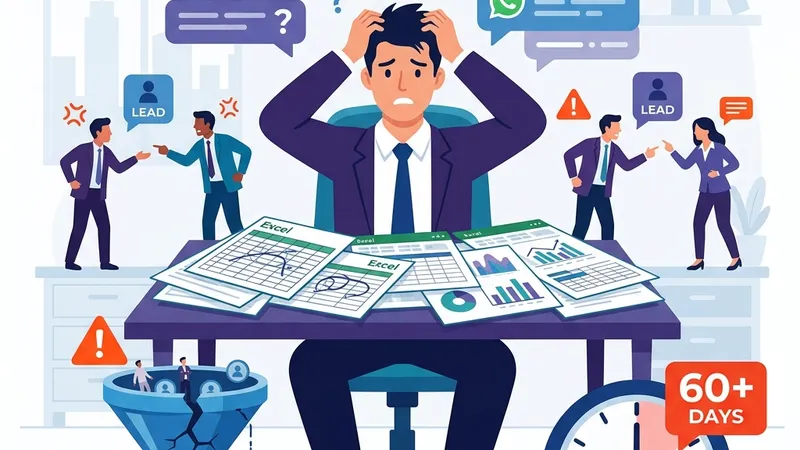
Here's what breaks:
- No lead attribution system — two CPs bring the same buyer, both claim the commission
- Delayed commission payouts — CPs wait 60-90 days (or more) while the developer "processes" payment
- Zero transparency — CPs can't see if their leads are being followed up or stolen by the in-house team
- No RERA compliance — unregistered agents expose the developer to regulatory penalties
- One-size-fits-all commissions — the CP who closes ₹20 Crore annually gets the same 1.5% as the one who closes ₹50 Lakh
The data reflects this chaos:
| Problem Area | Impact on Developer |
|---|---|
| Lead duplication disputes | 15-20% of CP leads are disputed — causing delays and damaged relationships |
| Delayed commission payouts | 35% of CPs deprioritize developers who pay late — they push competitor projects instead |
| No real-time inventory access | CPs promise sold-out units to buyers — creating buyer complaints and cancellations |
| Unregistered CPs | Risk of ₹10 Lakh+ RERA penalties per unregistered agent (varies by state) |
| Manual tracking (Excel/WhatsApp) | 25% of lead data is lost or misattributed when managed manually |
"We tracked our brokerage channel across four Bengaluru projects and found that 22% of commission disputes were caused by a single issue: no timestamped lead registration system. Once we moved to a CRM with automated lead-stamping, disputes dropped to under 3%." — opZynic Research Team
How to Build a Real Estate Channel Partner Program That Sells
Here's the exact framework used by developers who consistently outsell their competitors through channel partners. Five layers. Each one builds on the previous.
Step 1: Legal Foundation — RERA-Compliant CP Agreements
Before onboarding a single partner, lock down the legal structure. Under the Real Estate (Regulation and Development) Act, every agent marketing or selling properties must be RERA-registered — non-compliance exposes both the developer and the CP to significant penalties.
Every CP agreement must include:
- RERA verification — Confirm the CP's active RERA registration number (state-specific: MahaRERA, K-RERA, T-RERA, etc.)
- Scope of services — Define exactly what the CP is authorized to do (lead generation, site visit accompaniment, documentation support)
- Commission structure — Written, signed, with exact trigger events (when commission becomes payable)
- Marketing guidelines — Strict rules on logo usage, pricing promises, and social media claims
- Lead registration rules — Clear first-come-first-served policy with timestamp requirements
- Dispute resolution — Defined escalation path for contested leads
- TDS compliance — Deduction under Section 194H of the Income Tax Act
Skip this step, and you're building on sand. Every CP dispute that escalates is a dispute that should have been prevented by a clause in this document.
Step 2: The 5-Tier Commission Structure That Motivates Selling
A flat commission rate kills motivation. Your top-performing CP shouldn't earn the same percentage as someone who sends one lead a quarter.

Here's a tiered model that works:
| Tier | Monthly Bookings | Commission Rate | Bonus |
|---|---|---|---|
| Bronze | 0-2 bookings | 1.5% of agreement value | — |
| Silver | 3-5 bookings | 2.0% | Early access to new inventory |
| Gold | 6-10 bookings | 2.5% | Priority marketing material + event invites |
| Platinum | 11-20 bookings | 3.0% | Dedicated relationship manager + quarterly bonus |
| Diamond | 21+ bookings | 3.5% + performance bonus | Exclusive inventory rights + annual recognition |
Why this works: The jump from Bronze (1.5%) to Gold (2.5%) on a ₹80 Lakh flat means ₹80,000 more per sale for the CP. That's real money. That's motivation to push your project over the competition.
Payment rule: Commission must be processed within 15 business days of booking confirmation. Nothing kills CP loyalty faster than slow payment. If you're paying 60+ days out, your CPs are already selling someone else's project.
Step 3: Technology Stack — CRM, CP Portal & Lead Attribution
This is where most developers in India fail. They run their CP program on WhatsApp groups and Excel sheets. That's not a system — that's a liability.
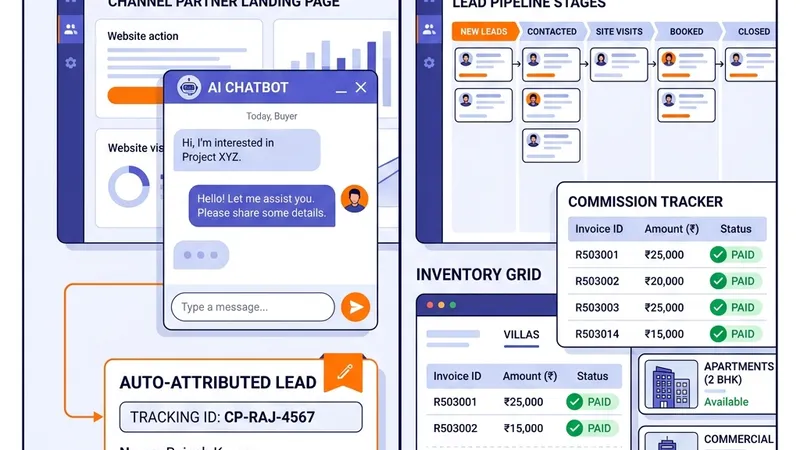
Your CP technology stack needs three components:
A) Real Estate CRM with CP Module
Your CRM must support dedicated CP workflows. At minimum:
- Automated lead registration with timestamp
- Lead-to-CP attribution tracking
- Commission calculator linked to your tiered structure
- Real-time inventory visibility for CPs
B) Channel Partner Portal / App
Give CPs their own login where they can:
- Register leads themselves (with timestamp = proof of first contact)
- Track lead status (new → contacted → site-visit-booked → booked → registered)
- View real-time inventory and pricing
- Download approved marketing collateral
- See pending and paid commission amounts
C) AI Chatbot on CP Landing Pages
Here's the approach that most developers haven't figured out yet. Your top CPs run their own landing pages and social media ads. When a buyer clicks their ad and lands on their page, what happens?
Usually: a static contact form. The buyer leaves in 30 seconds.
The fix: embed an AI chatbot on every CP's landing page. The chatbot:
- Engages the buyer instantly (under 2 seconds)
- Qualifies their budget, timeline, and preferences
- Auto-attributes the lead to the correct CP (via unique tracking IDs)
- Sends the qualified lead directly into your CRM
- Books a site visit — all before your in-house team even wakes up
Based on our deployment across 50+ real estate projects, CPs using AI chatbots on their landing pages capture 3× more qualified leads than those using static forms. That means more commissions for the CP and more site visits for you.
💡 Quick win: If you want to give your channel partners AI-powered landing pages that capture leads 24/7, see how opZynic works →
Step 4: Onboarding, Training & Ongoing Engagement
Signing a CP agreement isn't the finish line — it's the starting line.
Week 1 Onboarding Checklist:
- [ ] RERA registration verified and documented
- [ ] CP agreement signed with tiered commission structure
- [ ] CRM/portal login credentials issued
- [ ] Sales kit delivered: digital brochure, floor plans, price sheet, site visit booking link
- [ ] 30-minute project walkthrough (on-site or virtual)
- [ ] Unique tracking link or chatbot embed code issued
Monthly Engagement:
- Share construction updates with photos and videos (CPs pass these to buyers — instant credibility)
- Host a monthly "CP Connect" call — share inventory updates, sales velocity, and success stories
- Distribute offer frameworks they can pitch — payment plans, early-bird pricing, NRI packages
- Recognize top performers publicly — a WhatsApp shoutout costs you nothing and means everything
Quarterly Review:
- Performance review per CP: leads generated → qualified → site visits → bookings
- Tier adjustment based on quarterly numbers
- Identify underperformers — either coach them or offboard them
- Collect market intelligence: what objections are buyers raising? Which competing projects are CPs also pitching?
Step 5: Performance Tracking & Lead Quality Management
A CP program without performance tracking is just a cost center.
Track these metrics for every channel partner:
| Metric | What It Tells You | Action If Poor |
|---|---|---|
| Lead Volume | How many leads they're generating | Low volume → CP isn't marketing your project actively |
| Lead-to-Qualification Rate | Quality of leads submitted | Low rate → CP is sending unqualified traffic |
| Site Visit Conversion | Are qualified leads actually visiting? | Low conversion → your follow-up process is broken |
| Booking Rate | End-to-end performance | Low rate → pricing issue, or CP isn't closing |
| Avg. Response Time | Speed of follow-up on CP leads | Slow response → leads going cold (the hidden cost) |
| Commission Efficiency | Cost per booking through this CP | High cost → evaluate whether this CP tier is sustainable |
Use your lead scoring system to grade CP leads on arrival. Hot leads get immediate attention. Warm leads go into nurture sequences. Cold leads — don't waste your sales team's time.
Case Study: How a Bengaluru Developer Rebuilt Their CP Program and Increased Bookings by 40%
A mid-sized developer in Bengaluru's Sarjapur Road corridor had a classic problem: 40+ registered channel partners, but only 6-8 were actually producing bookings. The rest? Dormant.
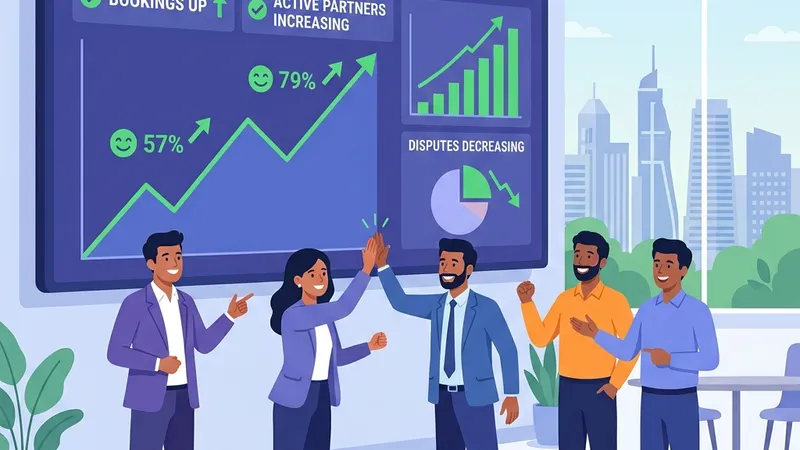
What they changed:
- Moved from WhatsApp to CRM — Every CP got a portal login with real-time lead tracking
- Implemented 5-tier commissions — Top CPs jumped from 1.5% to 2.5%, earning ₹2 Lakh+ more per quarter
- Added AI chatbots to CP landing pages — 12 CPs embedded chatbots within the first month
- Started monthly CP Connect calls — Shared inventory updates, recognized top performers
- Enforced 15-day payment cycles — No more 60-day waits
Results (over 6 months):
| Metric | Before | After | Change |
|---|---|---|---|
| Active CPs (producing bookings) | 8 of 40 | 28 of 42 | +250% |
| CP-generated leads/month | 85 | 310 | +265% |
| Lead-to-site-visit rate | 8% | 22% | +175% |
| Monthly bookings via CPs | 6 | 25 | +317% |
| Commission dispute tickets | 12/month | 2/month | -83% |
| Avg. commission payout time | 58 days | 12 days | -79% |
The biggest insight? The majority of "inactive" CPs weren't lazy. They just couldn't see their lead status, didn't trust the payment timeline, and lacked the tools to sell effectively. Fix the system, and the CPs activate themselves.
Channel Partner vs Broker: What's the Difference?
This confusion costs developers time and money. Let's settle it.
| Factor | Channel Partner | Traditional Broker |
|---|---|---|
| Relationship | Formal, long-term agreement with specific developer | Independent, works with multiple developers |
| Commission Source | Paid by the developer | Often charged to the buyer |
| Lead Attribution | Tracked through CRM/portal | Manual, often verbal |
| Inventory Access | Real-time, via portal | General market knowledge |
| RERA Requirement | Mandatory | Mandatory |
| Marketing | Uses developer-approved materials | Creates own marketing |
| Exclusivity | Often exclusive to 2-3 developers | Works with anyone |
The key takeaway: A channel partner is a managed, accountable extension of your sales team. A traditional broker is an independent agent. Both are valuable — but a CP program gives you control, data, and predictability that informal broker networks simply don't.
FAQ: Real Estate Channel Partner Program Questions
How much commission do real estate channel partners get in India?
Channel partner commissions in India typically range from 1% to 3.5% of the property agreement value for primary sales. The exact rate depends on the developer's tier structure, property type, and market conditions. Commercial properties often command 2% to 5% due to higher transaction complexity. A performance-based tiered structure (1.5% base, scaling to 3.5% for top performers) delivers the best results for both developers and CPs.
Is RERA registration mandatory for channel partners?
Yes. Under the Real Estate (Regulation and Development) Act, every real estate agent — including channel partners — must be registered with the state RERA authority (MahaRERA, K-RERA, T-RERA, etc.) to legally market or sell properties. Operating without RERA registration exposes both the agent and the developer to fines of up to ₹10 Lakh or 5% of project cost (varies by state). You can verify agent registrations directly on your state RERA portal.
How do I resolve lead disputes between channel partners?
The only reliable solution is a timestamped lead registration system integrated into your CRM. When a CP registers a lead, the system records the exact date, time, and source. If two CPs claim the same buyer, the timestamp settles it. Additionally, require that the CP accompanies the buyer on their first site visit and have the buyer acknowledge the CP on an inquiry form.
What should a channel partner agreement include?
A robust CP agreement must include: RERA registration requirement, clearly defined commission tiers and payment triggers, lead registration and attribution rules, marketing usage guidelines, non-compete or multi-brand clauses, TDS deduction terms (under Section 194H), dispute resolution procedures, and termination conditions. Always have it vetted by a real estate attorney.
What CRM tools help manage channel partners in real estate?
Popular real estate CRMs with CP management modules in India include Sell.Do, PropFlo, LeadSquared, and BeyondWalls. The key features to look for: dedicated CP login portal, real-time inventory visibility, automated commission calculation, lead attribution tracking, and chatbot integration for CP landing pages.
Is Your CP Program Costing You Bookings?
If you're managing channel partners through WhatsApp groups and Excel sheets, you are leaving bookings on the table. Every lead that isn't timestamped is a future dispute. Every CP who can't see their commission status is a CP pitching your competitor's project instead.
A structured real estate channel partner program — with RERA compliance, tiered commissions, CRM tracking, and AI-powered tools — turns your broker network from a cost center into a predictable revenue engine.
The developers who sell out projects in 6 months aren't spending more on ads. They're building better systems for the people who actually sell their properties: their channel partners.
Ready to give your channel partners AI-powered tools that capture leads 24/7? Start your free opZynic trial today →
Want to see how AI chatbots on your CP landing pages can triple their lead capture rate? Book a free demo →
Related Articles
Ready to Convert More Leads?
See how opZynic can transform your real estate website into a 24/7 sales machine.
Start Free Trial